7 Best White Keyboard Picks for Office Use
The SOLAKAKA A75 Wireless Gaming Keyboard is the best white keyboard for most buyers because its 75% layout saves desk space without removing the arrow keys or function row. It gives shoppers a practical middle ground between a full-size board and a tiny 60% model, with a light case color that suits clean desk setups. Its wireless design also helps reduce cable clutter, though buyers should check the included connection options before ordering.
This guide is for gamers, students, and office users who want a pale keyboard that looks neat and feels useful every day. The key factors are layout size, switch type, keycap material, and battery life, since each affects comfort, sound, durability, and charging frequency. The seven picks below are ranked by their strengths, with clear reasons and honest drawbacks for each. That makes it easier to match a board to your desk, budget, and typing habits.
Quick Comparison
| # | Product | Best For | Price | |
|---|---|---|---|---|
| 1 | SOLAKAKA A75 Wireless Gaming Keyboard | Budget wireless gaming setups | ~$76 | View → |
| 2 | Logitech MK270 Wireless Keyboard and Mouse Combo | Home office keyboard-and-mouse users | ~$30 | View → |
| 3 | HUO JI E-Yooso Mechanical Keyboard | RGB mechanical keyboard newcomers | ~$45 | View → |
| 4 | AULA F75 Pro Wireless Mechanical Keyboard | Compact wireless keyboard enthusiasts | ~$83 | View → |
| 5 | Logitech Signature Slim K950 Wireless Keyboard | Multi-device office workers | ~$90 | View → |
| 6 | TMKB 60% Mechanical Gaming Keyboard | Small-desk PC gamers | ~$34 | View → |
| 7 | GravaStar Mercury K1 Wireless Mechanical Keyboard | Style-focused wireless keyboard fans | ~$140 | View → |
7 Top White Keyboard Picks
These keyboard picks are ranked by features, typing feel, connectivity, and value, counting down to the top choice.
7. GravaStar Mercury K1 Wireless Mechanical Keyboard

Best for: White-themed wireless gaming desks
The GravaStar Mercury K1 is a 75% wireless mechanical keyboard with 79 keys. Its aluminum alloy outer frame gives the board a solid structure, while the compact layout leaves more room for a mouse. Dual-layer PBT keycaps should resist shine better than standard ABS caps. Around $140, it sits in the premium compact-keyboard range.
GravaStar pairs the K1 with linear Kailh switches rated for 40g actuation and 1.5mm pre-travel. That setup should feel light and quick for gaming, while the gasket-mounted PC plate and five-layer sound treatment aim to reduce harsh key noise. The company claims the dampening system absorbs 87% of impact vibrations, though that figure is difficult to judge without standardized testing. You get 2.4GHz wireless, Bluetooth 5.0, and USB-C wired modes, plus an 8000mAh battery. RGB lighting offers 16.8 million colors and 13 effects. GravaCore adds per-key controls, macros, and eight profiles.
Pros
- Three connection modes support PCs, Macs, and multiple devices.
- The 79-key layout saves desk space without removing arrow keys.
- Linear switches, 1.5mm pre-travel, and per-key RGB suit gaming setups.
Cons
- The 75% design omits a number pad, which can slow spreadsheet work.
- GravaStar does not provide a specific battery-life estimate, especially with RGB active.
6. TMKB 60% Mechanical Gaming Keyboard

Best for: Small desks and portable gaming
The TMKB 60% mechanical keyboard keeps the main typing keys in a compact ANSI layout. It uses red linear switches with a 45g actuation force, so each press feels light and smooth. That setup suits fast games and everyday typing. Foldable feet add a small tilt for a more comfortable desk position.
Its strongest feature set comes from the 61-key rollover and 15 LED modes. Anti-ghosting helps register multiple key presses during busy games, while brightness and speed controls let you adjust the lighting. Double-shot keycaps keep the legends from wearing away quickly and allow the backlight to show through. The detachable USB-C cable is easier to replace or pack than a permanently attached lead. It works with Windows, Linux, and macOS without extra software. The white finish looks clean, though it may show dust more readily than darker keyboards. Rated switch life reaches 50 million presses. At around $34, it offers useful mechanical features without a full-size footprint.
Pros
- Compact 60% layout frees desk space and travels easily.
- Light 45g red switches support quick, smooth key presses.
- USB-C cable, 61-key rollover, and macOS, Windows, and Linux support add flexibility.
Cons
- The 60% layout removes dedicated arrow keys, function keys, and a number pad.
- Wired operation limits placement compared with wireless keyboards.
5. Logitech Signature Slim K950 Wireless Keyboard
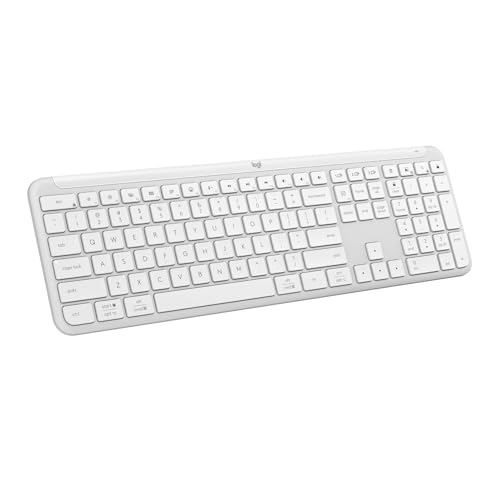
Best for: Quiet multi-device home offices
The Logitech Signature Slim K950 is a full-size wireless keyboard with a low-profile, laptop-style layout. It connects to Windows, macOS, Chrome OS, Linux, iPadOS, iOS, and Android through Bluetooth or a Logi Bolt receiver. Windows 11 users get full compatibility. A three-device switch lets you move between a computer, tablet, and phone by pressing one of three dedicated buttons.
Quiet keys make this a practical choice for shared rooms, bedrooms, and workspaces near other people. The keyboard uses recycled plastic and has a slim design, though Logitech does not list a specific height or weight in the supplied details. One-touch controls cover volume, media playback, mute, and screen snipping. The Logi Options+ app, available for Windows and macOS, lets you customize supported keys for different tasks. At around $90, it costs more than basic wireless keyboards, but the multi-device controls add useful flexibility. You can also pair it with the Signature Mouse M650 for a matching setup, though that mouse is sold separately.
Pros
- Switches between three paired devices with dedicated keys.
- Quiet, full-size layout suits shared work areas.
- Works across major desktop and mobile operating systems.
Cons
- Around $90 is expensive for a keyboard without a bundled mouse.
- Key customization requires the Logi Options+ app, which is limited to Windows and macOS.
4. AULA F75 Pro Wireless Mechanical Keyboard
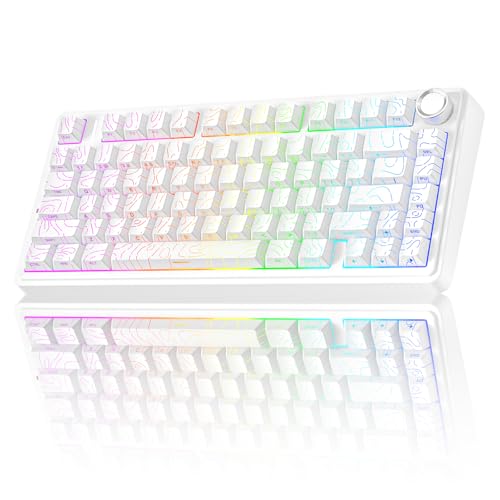
Best for: Compact gaming and office setups
The AULA F75 Pro is an 81-key, 75% mechanical keyboard with arrow keys, a function row, and a multi-purpose control knob. It connects through Bluetooth 5.0, 2.4GHz wireless, or USB, with support for switching among up to five devices. A 4000mAh battery supports cable-free use, while compatibility includes computers, tablets, phones, and some consoles. At around $83, it offers a substantial feature set for a mid-priced custom board.
Its hot-swappable PCB accepts both 3-pin and 5-pin switches, so you can change the typing feel without soldering. The included LEOBOG Star Vector switches and pre-lubricated stabilizers should provide a smoother, quieter sound profile. A gasket structure, five internal dampening layers, and silicone padding add softness and reduce hollow case noise. Side-printed PBT keycaps resist shine better than ABS plastic, while RGB lighting passes through the legends. The knob adjusts volume or lighting, depending on its selected mode.
Pros
- Tri-mode connectivity supports Bluetooth, 2.4GHz, and USB use.
- Hot-swap support makes switch changes accessible without soldering.
- PBT keycaps, layered dampening, and gasket mounting improve durability and sound control.
Cons
- The 75% layout omits a dedicated number pad, which may slow data entry.
- Custom lighting and macro controls depend on the F75 driver software.
3. HUO JI E-Yooso Mechanical Keyboard
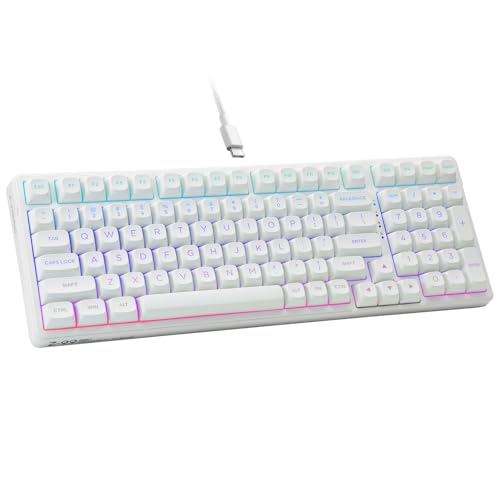
Best for: Compact wired gaming and office setups
The HUO JI E-Yooso Creamy is a wired mechanical keyboard with a 99-key, 96% layout. It measures about 39 x 13.5 x 4 cm, so it takes less desk space than a full-size board while keeping a number pad. A detachable USB-C to USB-A cable makes storage and cable replacement easier. At around $45, it targets buyers who want mechanical switches and lighting without moving into premium pricing.
Its hot-swap PCB accepts both 3-pin and 5-pin switches, and the included puller tools let you change switches or keycaps without soldering. The pre-lubed linear switches should provide a smooth, quick feel, though switch preference varies. Five sound-dampening foam layers and a silicone pad sit inside the gasket-style construction. The manufacturer claims these materials cut noise by 40% and hollow sound by 80%, but room acoustics and typing force will affect the result. RGB lighting offers 15 effects, eight solid colors, adjustable speed, and brightness. Double-shot PBT keycaps resist printed legends wearing away.
Pros
- Hot-swap support works with 3-pin and 5-pin switches.
- Compact 99-key layout keeps a number pad in 39 cm of width.
- PBT keycaps and 15 RGB effects add durability and customization.
Cons
- Wired USB connection limits placement and adds another cable.
- The compressed 96% layout may require adjustment if you prefer wider spacing.
2. Logitech MK270 Wireless Keyboard and Mouse Combo

Best for: Budget home-office desktop setups
The Logitech MK270 combines a full-size wireless keyboard with a compact mouse for around $30. Its USB receiver supports a connection up to 33 feet, giving you room to move around a desk or living room setup. The keyboard uses a standard layout with full-size F-keys, arrow keys, and a number pad. Eight hotkeys provide quick controls for email, web browsing, media playback, and volume.
Low-profile keys keep typing quieter than many older desktop keyboards. The spill-resistant design, sturdy tilt legs, and adjustable height add practical value, though this is still an entry-level set. Logitech rates the keyboard battery for up to 36 months and the mouse battery for up to 12 months, with power switches on both devices. The mouse works for left- or right-handed users and tracks across most surfaces. Off-white plastic gives it a softer look, while recycled content makes up 54% of the keyboard and 49% of the mouse.
Pros
- Full-size layout includes a number pad and dedicated arrow keys.
- Long battery ratings reduce frequent battery changes.
- Eight shortcut keys handle media, email, web, and volume controls.
Cons
- The compact mouse may feel cramped for users with large hands.
- No backlighting is listed, so the keys may be harder to see in dim rooms.
1. SOLAKAKA A75 Wireless Gaming Keyboard

Best for: Compact multi-device gaming setups
The SOLAKAKA A75 is a wireless 75% mechanical keyboard with 81 keys, arrow keys, and a multifunction knob. It connects through 2.4GHz wireless, Bluetooth 5.0, or USB-C, and can pair with up to five devices. Windows, Mac, and iOS support make it useful across computers and tablets. Its 4,000mAh battery suits daily use, though the listed features do not provide a battery runtime estimate. The price is around $76, which places it above many basic wireless keyboards.
Its strongest feature is the ready-to-customize mechanical design. The hot-swappable PCB accepts 3-pin and 5-pin switches without soldering. Included LEOBOG Caramel Latte switches, pre-lubricated stabilizers, and a gasket build aim for a softer feel and lower-pitched sound. Internal IXPE, PET, and PO foam layers help reduce hollow noise. The transparent PC outer keycaps with ABS inner layers give the RGB lighting a bright, exposed look. Seventeen lighting effects, N-key rollover, Windows-key lock, and programmable software add useful control for gaming and work. The knob changes lighting in gaming mode, then controls volume in office mode.
Pros
- Three connection options support computers, tablets, and phones.
- Hot-swappable sockets allow switch changes without soldering.
- Compact 81-key layout keeps arrow keys while saving desk space.
Cons
- The 75% layout does not include a dedicated number pad.
- Transparent crystal keycaps may look less familiar than opaque keycaps.
Buying Guide
Switch feel and layout matter most when choosing a white keyboard. They control typing comfort, desk space, and daily productivity more than the color or lighting.
- Switch type: Choose linear switches for smooth, quiet presses, tactile switches for noticeable feedback, or clicky switches for louder typing. A hot-swappable model lets you change switches later without soldering.
- Layout and size: Pick a full-size board for a number pad, a tenkeyless model to save about 4 inches of width, or a 60% board for compact desks. Confirm that the layout matches your computer.
- Keycap material: Prefer double-shot PBT keycaps for sharper legends and better wear resistance. ABS caps usually cost less but can become shiny after months of frequent use.
- Connection and battery: Wired models avoid charging delays. For wireless use, seek at least 40 hours of battery life, Bluetooth plus 2.4GHz support, and a USB receiver stored in the case.
- Price and extras: Expect to spend $40 to $80 for a basic white board and $90 to $180 for mechanical features. Check for backlighting, adjustable feet, a detachable cable, and a two-year warranty.
If you cannot have everything, prioritize switch comfort and the layout that fits your daily work.
Frequently Asked Questions
How do I choose the right white keyboard?
Choose a white keyboard by matching its switch type, layout, connection, and cleaning needs to your setup. Linear switches feel smooth, tactile switches provide a bump, and low-profile boards save desk space. A 75% layout keeps most arrow keys while cutting several inches from a full-size model.
What features matter most in a white keyboard?
Look for PBT keycaps, adjustable backlighting, stable wireless support, and a layout that matches your work. PBT resists shine better than ABS, while hot-swappable sockets let you change compatible switches without soldering. Check battery capacity too, since wireless run time can range from about 20 to 200 hours.
Can white mechanical keyboards work well for gaming?
Yes, white mechanical keyboards can suit gaming, but color does not determine performance. Prioritize a reliable connection, low input delay, rollover support, and switches you can control comfortably. A wired USB model avoids charging, while 2.4GHz wireless boards often provide roughly 30 to 100 hours per charge.
Are white keyboards difficult to keep clean?
No, white keyboards are manageable to clean, but they show dust, skin oils, and discoloration more clearly than darker models. Use a soft brush weekly and wipe the keycaps with a lightly damp cloth. Remove loose keycaps only when the manufacturer permits it, since clips can break.
Conclusion
The SOLAKAKA A75 Wireless Gaming Keyboard is the top pick for gamers who want a compact white board with wireless flexibility and a feature-focused layout. If your priority is a quieter office setup, choose a low-profile or membrane alternative instead, since those designs usually produce less key noise in shared workspaces. Before buying, double-check the keyboard’s size, device compatibility, listed quantity, and current price, especially when comparing single boards with bundles. Also confirm the connection type, charging setup, and operating-system support. A 75% layout saves desk space but drops some dedicated keys, so make sure its missing controls will not slow down your daily work or gaming sessions. A clean white finish also shows dust more clearly.