
5 Best On Camera Flash for Sony A7RIII for Events
For most buyers, the GODOX iT32 TTL Camera Flash is the best on camera flash for sony a7riii because its compact TTL design keeps setup simple without adding much bulk.
This guide is for Sony A7R III owners who want more control over indoor portraits, events, and fill light without carrying a larger speedlight. The two key buying factors are Sony TTL compatibility and battery life. A small unit can fit a compact camera bag, but shorter battery life may slow down longer sessions. The five picks below are ranked with clear reasons and honest drawbacks for each, so you can match a flash to your lens, shooting style, and budget.
Quick Comparison
| # | Product | Best For | Price | |
|---|---|---|---|---|
| 1 | GODOX iT32 TTL Camera Flash | Compact TTL Flash Shooters | ~$104 | View → |
| 2 | ULANZI SL01 Mini Camera Flash | Minimalist Point-and-Shoot Users | ~$17 | View → |
| 3 | Godox TT520III Universal Speedlite Flash | Budget Manual Flash Beginners | ~$64 | View → |
| 4 | VILTROX GN12 TTL Camera Flash | Sony TTL Event Photographers | ~$55 | View → |
| 5 | Godox V1-S Flash Speedlite | Portrait Photographers Wanting Round Light | ~$199 | View → |
5 Top On-Camera Flashes for Sony A7R III
These picks are ranked by compatibility, power, controls, and value, counting down to the strongest overall choice.
5. Godox V1-S Flash Speedlite

Best for: Sony portrait shooters needing TTL
The Godox V1-S is a 76Ws flash designed for Sony cameras, including the a7 III, a7R IV, a9, A7C, ZV-E10, a6400, and a6600. It supports TTL autoflash, manual output, flash exposure compensation, exposure lock, second-curtain sync, and modeling light. High-speed sync reaches 1/8000 second, which helps control bright outdoor scenes and wide apertures.
Its round flash head is the main design difference from many rectangular speedlights. The shape spreads light more evenly from the center toward the edges, which can produce softer portrait lighting. A built-in 2.4G wireless X system supports remote triggering and optical communication at distances up to 100 meters. The rechargeable lithium battery recycles in as little as 1.5 seconds and provides about 450 full-power flashes per charge. Around $199, it offers strong control for Sony users who want one compact flash for on-camera and off-camera work.
Pros
- 76Ws output provides more lighting headroom than basic compact flashes.
- High-speed sync works up to 1/8000 second for outdoor portraits.
- Lithium battery delivers about 450 full-power flashes per charge.
Cons
- Compatibility is aimed at Sony cameras, so it is not a flexible choice for mixed-brand kits.
- Wireless range and optical triggering can depend on placement, obstacles, and ambient light.
4. VILTROX GN12 TTL Camera Flash
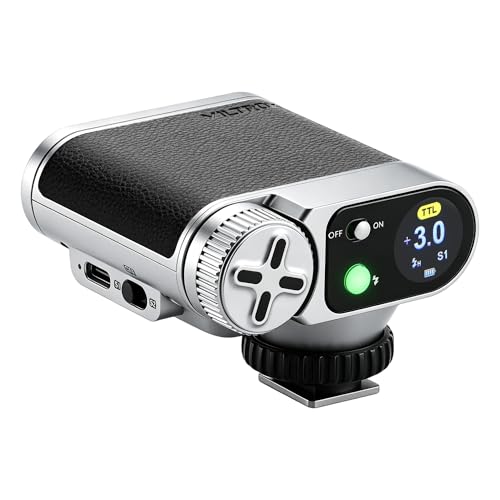
Best for: Sony portrait shooters needing HSS
The VILTROX TTL Flash is a small, rechargeable camera flash with a guide number of GN12. It supports TTL exposure on Sony cameras and high-speed sync up to 1/8000 second. That makes it useful for outdoor portraits, backlit subjects, and wide-aperture shots in bright conditions. Manual mode also works with Nikon, Canon, Fujifilm, Ricoh GR3, Leica, and other single-contact hot shoes, though TTL is not available on those systems.
Its built-in battery recharges through USB-C in about 70 minutes and provides up to 350 full-power flashes, or as many as 10,000 at minimum power. Full-power recycling takes up to one second, and the flash can operate while charging. Controls use a 2.5D curved glass color touchscreen, with adjustable brightness and a custom boot image option through a Windows PC. The 1/1 to 1/64 range offers seven power levels, plus one-third-stop adjustments. At around $55, it packs useful control into a compact flash, but its modest GN12 output limits reach.
Pros
- Sony TTL and 1/8000-second HSS simplify outdoor portrait exposure.
- USB-C charging and up to 350 full-power flashes suit event sessions.
- S1 and S2 optical slave modes support basic multi-light setups without a trigger.
Cons
- TTL works with Sony only. Other listed camera systems use manual mode.
- GN12 output is limited for large rooms, distant subjects, or bounced lighting.
3. Godox TT520III Universal Speedlite Flash

Best for: Budget manual off-camera flash setups
The Godox TT520III is a manual speedlight for cameras with a standard single-contact hot shoe. It works with Canon, Nikon, Fuji, Olympus, Panasonic, Pentax, Leica, and Ricoh bodies, plus many Sony cameras. It does not provide TTL exposure control, so you set the output yourself. The package includes a wireless transmitter, diffuser kit, built-in reflector, and support for S-R1, S-R2, and PB960 accessories.
Its GN33 output is useful for portraits, events, and bounced indoor photos. You can adjust power across eight stops, from 1/128 to full power, with ±1/3-stop fine-tuning. The head turns 330 degrees horizontally and tilts through 120 degrees. At full power, recycling takes about 1.8 seconds, while four separate AAA batteries support up to 400 full-power flashes. S1 and S2 optical slave modes add flexible off-camera use. Around $64, it offers more control than a basic on-camera flash, but Sony ZV-1F owners should avoid it because this camera is specifically listed as incompatible.
Pros
- Eight power levels and fine adjustments support careful manual exposure.
- 330-degree rotation and 120-degree tilt make bounce lighting easier.
- Wireless triggering, S1, and S2 modes support several off-camera setups.
Cons
- No TTL automation, so exposure settings require manual adjustment.
- Four AAA batteries are sold separately, and Sony ZV-1F is incompatible.
2. ULANZI SL01 Mini Camera Flash

Best for: Compact manual flash users
The ULANZI SL01 is a small, on-camera speedlite for cameras with a single-contact hot shoe. It uses manual output rather than TTL automation, with four power levels: 1/1, 1/2, 1/4, and 1/8. Its GN8 rating at ISO 100 suits nearby portraits, tabletop photos, and casual indoor scenes, but it is not a long-range flash. The 6500K light has a stated CRI of 97 or higher, which should help preserve color under consistent conditions.
The built-in 250mAh lithium battery provides more than 500 full-power flashes per charge, according to the listed specifications. USB-C charging at 5V/1A takes about 60 minutes, and the flash can operate while charging. At 0.07 pounds, it adds little weight to a camera bag. Around $17, it offers basic flash control at a low cost. The package includes the flash and manual, but no charging cable or wall charger.
Pros
- Four manual power levels provide control over flash brightness.
- A 250mAh battery supports over 500 full-power flashes per charge.
- The 0.07-pound body is easy to carry with a small camera kit.
Cons
- It has no TTL, so exposure and flash output require manual adjustment.
- Compatibility is limited to suitable single-contact hot shoes, with several camera models specifically excluded.
1. GODOX iT32 TTL Camera Flash

Best for: Sony shooters building compact off-camera kits
The GODOX iT32 pairs a camera flash with the X5S trigger for Sony cameras such as the A7 III, A7 IV, ZV-E10, and a6700. It costs around $104, though prices change. The flash includes a built-in 2.4GHz receiver, while the X5S sends the wireless signal. Together, they can control the iT32 and other Godox Wireless X flashes without manual pairing.
The X5S works on the camera hot shoe or as a separate wireless transmitter. Its interchangeable magnetic hot shoe lets you switch camera systems by changing the X5 version. Attached to the iT32, it supports on-camera shooting. Detached, it controls off-camera lighting. The iT32 recognizes the attached X5 model and shows its battery and charging status. A touchscreen, flexible flash head, built-in reflector and diffuser, magnetic connection, and USB-C charging round out the design. The system suits photographers who want one compact setup for direct flash and multi-light work.
Pros
- Supports many Sony bodies, including the A7 III, A7 IV, ZV-E10, and a6700.
- Switches between on-camera use and wireless triggering.
- Includes a 2.4GHz system, touchscreen, flexible head, reflector, diffuser, and USB-C charging.
Cons
- Buyers must choose the correct X5 hot shoe version for their camera system.
- The listing does not state flash power, recycle time, or battery life, making performance harder to judge.
Buying Guide
The most important factor is Sony TTL compatibility. A flash designed for the A7R III can calculate exposure automatically and support high-speed sync for shutter speeds above 1/250 second.
- Sony support: Choose a unit made for Sony’s Multi Interface Shoe with TTL and HSS. Avoid models labeled only for Canon, Nikon, or universal manual use.
- Light output: Look for a guide number of at least 40 meters at ISO 100. That gives useful reach for bounce lighting in medium-sized rooms.
- Recycle time: A recycle time of 1.5 to 3 seconds works well for portraits and events. Faster recycling matters when subjects move or expressions change quickly.
- Power source: Four AA batteries are common and easy to replace. Rechargeable NiMH cells can reduce running costs, while a lithium model may offer shorter recycle times and more shots per charge.
- Head movement and size: Choose a head that tilts at least 90 degrees and swivels about 270 degrees. A flash under 2 pounds is easier to hold above the camera for long sessions.
- Price and triggers: Expect roughly $150 to $500 for a reliable TTL flash. Built-in radio control is useful if you plan to add an off-camera unit later.
If you cannot have everything, prioritize confirmed Sony TTL and HSS support before power, speed, or extra features.
Frequently Asked Questions
How do I choose an on-camera flash for the Sony A7R III?
Choose a Sony-compatible TTL flash with a Multi Interface Shoe, adjustable tilt and swivel, and enough output for your shooting distance. Look for a guide number near 40 to 60, plus a rechargeable battery or common AA cells. Sony TTL support preserves automatic exposure, while high-speed sync helps with faster shutter speeds.
What guide number should a flash have for the Sony A7R III?
A guide number from 40 to 60 is practical for most Sony A7R III photographers. At ISO 100, a GN 60 flash can provide useful exposure at roughly 15 feet at f/4, before bounce or modifiers reduce output. A smaller GN 30 model works for nearby indoor subjects and casual portraits.
Can I use a third-party flash with the Sony A7R III?
Yes, you can use a third-party flash if it has a Sony-compatible foot and supports the camera’s TTL system. Check the manufacturer’s compatibility list before buying. Some flashes provide TTL and high-speed sync, while others operate only in manual mode and require you to set power levels yourself.
Are radio triggers necessary for using a flash with the Sony A7R III?
No, radio triggers are not necessary for mounting one compatible flash directly on the camera. They become useful when placing a light several feet away or behind the subject. A Sony-compatible transmitter and receiver can provide wireless control across ranges commonly listed between 30 and 100 feet.
Conclusion
The GODOX iT32 TTL Camera Flash is the top pick for Sony A7R III owners who want a compact, TTL-capable light for portraits, events, and everyday carry. If your priority is faster recycling or more output for large rooms, choose the Godox V1-S instead, provided you confirm the Sony version and your trigger setup. Before buying, double-check the flash’s physical size, direct compatibility with the A7R III, package contents, and current price, since listings can vary by seller. Also confirm whether you need a transmitter, diffuser, batteries, or a stand separately. Matching the flash, camera, and accessories carefully can prevent expensive surprises after checkout.