6 Best Flashlight Power Bank for Camping
The BLAVOR Solar Power Bank is the best flashlight power bank for most buyers because it combines emergency lighting with portable charging in one device. Its solar-power-bank design suits camping kits, car emergency bags, travel, and short outages, while the built-in light adds useful backup when outlets are unavailable. It is a practical choice for shoppers who want fewer separate items to pack.
This guide is for campers, commuters, travelers, and anyone preparing for power cuts. When comparing these multi-use chargers, focus on overall size, battery capacity, light output, and expected battery life between charges. Charging speed and water resistance also matter if the unit will spend time outdoors. The 6 picks below are ranked by their useful features, with clear reasons and honest drawbacks for each, so you can match the light and charger to your routine.
Quick Comparison
| # | Product | Best For | Price | |
|---|---|---|---|---|
| 1 | BLAVOR Solar Power Bank | Off-grid hikers and campers | ~$40 | View → |
| 2 | Solar Charger Power Bank, 22.5W Portable Battery Pack | Fast phone top-ups outdoors | ~$43 | View → |
| 3 | Solar Charger Power Bank, 20,000mAh Portable Charger | Long weekend backup charging | ~$17 | View → |
| 4 | SOARAISE Solar Power Bank | Rugged travel power needs | ~$60 | View → |
| 5 | FosPower A1 Emergency Weather Radio | Emergency alerts during power outages | ~$33 | View → |
| 6 | INIU 45W Portable Charger Power Bank | Laptop users needing fast charging | ~$25 | View → |
6 Top Flashlight Charger Picks
This ranked list counts down to the top pick, with each option judged for flashlight output, battery capacity, and charging utility.
6. INIU 45W Portable Charger Power Bank

Best for: Travelers with USB-C gear
This compact power bank stores 10,000mAh and delivers up to 45W through its USB-C connection. It measures 4.3 by 2.7 by 0.7 inches, so it should fit in a pocket, clutch, or belt bag more easily than thicker battery packs. The built-in cable uses nylon braiding and doubles as a carry loop. A reinforced joint lets the cable bend during use, while the shell includes active heat dissipation.
The charging claims are strong for this size. INIU says lab testing reached 75% on a Samsung S26 Ultra in 30 minutes and 100% in 45 minutes. An iPhone 17 Pro reportedly reached 65% in 30 minutes. Actual speeds depend on the device and charging setup. The 45W output also supports devices such as the Steam Deck, Nintendo Switch, iPad Pro, and compatible cameras. Four paw-shaped lights show roughly 25% battery per light, and a built-in flashlight adds value during outages or nighttime travel. At around $25, the three-year replacement plan is a useful extra.
Pros
- 45W output can charge phones, tablets, handheld consoles, and cameras.
- Slim 0.7-inch body fits smaller bags and clothing pockets.
- Built-in braided USB-C cable reduces loose accessories.
Cons
- The fixed USB-C cable may not work with Lightning-only devices.
- Charging speeds vary by device, and the advertised times may not apply broadly.
5. FosPower A1 Emergency Weather Radio

Best for: Home emergency weather kits
The FosPower A1 is a compact emergency radio with NOAA, AM, and FM reception. Its built-in 7,400mWh battery stores 2,000mAh of power for emergency charging of a phone or small tablet. You can recharge the unit through its solar panel or hand crank, then use AAA batteries when those options are not practical. The orange housing also makes it easier to spot in a drawer or emergency bag.
Lighting is built in, too. A four-LED reading light helps illuminate a room, while the separate 1W flashlight handles more focused tasks. The radio can receive emergency weather updates and news broadcasts, which gives it more value than a basic flashlight or battery bank. At around $33, it offers several backup tools in one device. FosPower also includes a limited lifetime warranty, though warranty coverage depends on the company’s terms.
Pros
- NOAA, AM, and FM reception provide access to weather alerts and news.
- The 2,000mAh power bank can provide emergency power for a phone or small tablet.
- A four-LED reading light and 1W flashlight cover two lighting needs.
Cons
- The 2,000mAh capacity is modest, so it may not fully recharge many modern phones.
- Solar charging depends on strong sunlight, while hand-crank charging requires repeated manual effort.
4. SOARAISE Solar Power Bank

Best for: Multi-device outdoor emergency charging
The SOARAISE is a large solar battery pack for camping, travel, and power outages. Its 48,000mAh lithium-polymer battery holds far more energy than a typical pocket charger, though its size adds bulk. Four solar panels fold into the body, giving the charger more surface area than single-panel models. The brand claims they collect sunlight up to five times faster than standard single-panel designs.
You get two USB-A outputs and one USB-C port that handles input and output at up to 5V/3A. Four built-in leads cover USB-C, a phone connector, USB-A, and Micro-USB devices. A wireless charging pad adds another option, with support for many recent iPhone and Samsung phones. The maker says the pack can power up to seven devices at once, but charging that many devices will divide its available output. Around $60, it costs more than basic power banks, yet the built-in cables reduce the need for extras.
Pros
- Four solar panels provide more charging area than single-panel designs.
- Four built-in cables cover common phone and accessory connections.
- Wireless charging, two USB-A ports, and USB-C support multiple devices.
Cons
- A 48,000mAh battery pack will be heavier and larger than standard travel chargers.
- Solar charging depends heavily on direct sunlight and may be slow in clouds, shade, or indoors.
3. Solar Charger Power Bank, 20,000mAh Portable Charger

Best for: Emergency kits and outdoor travel
This 20,000mAh portable charger provides backup power for phones, tablets, and other small devices. It has four built-in cables, USB-C input and output, plus USB-A output. The manufacturer says it can charge up to six devices at once, which may help during family trips or outages. Its 74Wh rating stays below the FAA’s 100Wh carry-on limit. Around $17, it also costs less than many rugged power banks.
The solar panel adds backup charging when outlets are unavailable, but sunlight-based charging can take a long time. Wall charging remains the practical choice for regular use. An IP65 rating protects against dust and rain, though it does not make the unit safe for submersion. Two LED flashlights offer steady, SOS, and strobe modes, while the built-in compass may help with basic outdoor navigation. The package includes a carabiner and manual. Claimed safety certifications include UL, FCC, CE, and RoHS, while the battery is rated for more than 1,500 recharge cycles.
Pros
- Four built-in cables reduce the need to pack separate charging cords.
- Dual flashlights include SOS and strobe modes for outages or nighttime travel.
- IP65 protection helps guard against dust and rain during outdoor use.
Cons
- Solar charging is slow and depends heavily on strong, direct sunlight.
- A 20,000mAh battery pack can be bulky compared with smaller travel chargers.
2. Solar Charger Power Bank, 22.5W Portable Battery Pack

Best for: Camping trips and emergency kits
This 38800mAh solar power bank provides backup power when outlets are unavailable. It supports USB-C input and output, USB-A output, and four built-in charging cables. The setup can power up to six devices at once, although charging speed will vary when several devices share power. USB-C output reaches 22.5W for compatible phones and other small electronics. Premium lithium-polymer cells and protection against overcharging, excess current, short circuits, and overheating add useful safeguards. It costs around $43, though prices can change.
The built-in solar panel offers an emergency recharge option for camping, hiking, storms, and outages. It should not replace wall charging, since solar output depends on sunlight and the panel’s exposed area. Two LED lights provide steady, SOS, and strobe modes for campsite lighting or signaling. An IP65 rating protects against dust and water splashes, but it is not designed for submersion. The package includes a lanyard and user manual. The listing does not provide dimensions or weight, so its packability is difficult to judge.
Pros
- Four built-in cables reduce the need to carry separate charging cords.
- 22.5W USB-C output can recharge compatible devices faster than basic USB ports.
- Dual LED lights include steady, SOS, and strobe settings for emergencies.
Cons
- Solar recharging is slow and depends heavily on strong sunlight and panel exposure.
- Dimensions and weight are not listed, making it harder to plan for limited backpack space.
1. BLAVOR Solar Power Bank
Best for: Hikers needing backup power
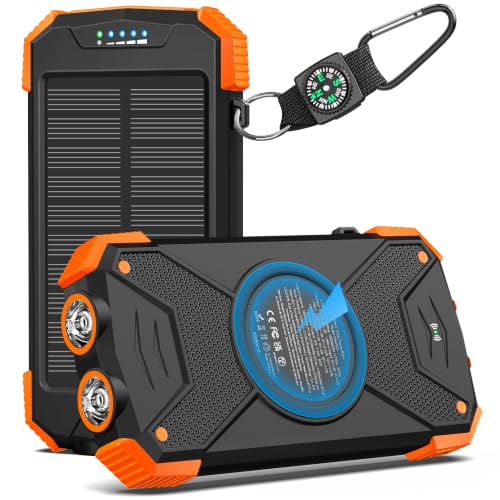
The BLAVOR Solar Power Bank is a 10,000mAh portable charger for phones, tablets, and other USB devices. It supports wireless charging plus USB-C input and output, with up to 20W wired charging. BLAVOR says it can charge an iPhone 15 to 65% in 30 minutes under its stated conditions. You can power three devices at once, though shared output may slow charging.
Its outdoor-focused shell uses flame-retardant ABS and PC plastic with silicone protection. IPX5 water resistance helps against spray, while the listed dustproof and shockproof design suits campsites and travel. Two bright flashlights, a compass, and a carabiner add useful emergency tools. The lithium-cobalt battery has a stated 10,000mAh capacity, with claimed examples of 3.6 iPhone 8 charges or 2.2 iPhone 14 Pro charges. Around $40, it costs more than basic wired power banks.
Pros
- 20W USB-C output can recharge compatible phones faster than standard 10W chargers.
- Wireless charging and three-device support reduce the need for extra cables.
- Flashlights, a compass, carabiner, and rugged shell suit outdoor emergencies.
Cons
- Solar charging works best as an emergency top-up, not as the main way to refill 10,000mAh.
- IPX5 protects against water spray, but the power bank should not be submerged.
Buying Guide
Battery capacity is the most important factor because it controls both flashlight runtime and phone-charging ability. A larger cell helps during outages, travel, and roadside emergencies.
- Battery capacity: Choose at least 10,000mAh for emergency use, or 20,000mAh if you need two or more phone charges. Actual output will be lower after conversion losses.
- Light performance: Look for a stated brightness of 300 to 1,000 lumens and at least 8 hours of runtime on a lower setting. Multiple brightness levels improve battery life.
- Charging output: Select USB-C Power Delivery at 18W or higher for faster phone charging. A second USB-A port helps charge two devices at once.
- Weather resistance: An IP65 rating protects against dust and water jets. Choose IP67 if the unit may face brief immersion, heavy rain, or wet camping conditions.
- Size and price: A 10,000mAh model should stay near 6 inches long and under 1 pound. Expect to pay about $25 to $60 for a reliable unit with USB-C charging.
If you cannot have everything, prioritize battery capacity, since it affects both lighting time and backup power.
Frequently Asked Questions
How many lumens should a flashlight power bank have for emergencies?
Choose a flashlight power bank with 300 to 1,000 lumens for most emergency use. Lower output works inside a tent or car, while 1,000 lumens helps light a yard. Look for several brightness modes, since a low setting can preserve battery power during outages lasting several hours.
What battery capacity is best for a flashlight charger?
A flashlight charger should have at least 10,000 mAh for useful emergency backup. That capacity can recharge many phones more than once, depending on the phone and conversion losses. Choose 20,000 mAh if you need several phone charges, but expect a larger and heavier unit.
Can a flashlight power bank charge a phone?
Yes, a flashlight power bank can charge most phones when it includes a compatible USB output and cable. Check the port before buying, since USB-C and USB-A connections differ. A 10-watt output is suitable for basic charging, while some phones need higher wattage for faster results.
Are flashlight power banks good for camping?
Yes, flashlight power banks are useful for camping because they combine area lighting, a focused beam, and phone charging in one device. Their main limitation is extra weight compared with a regular flashlight. A model with 10,000 mAh capacity can cover short trips without adding a separate battery pack.
Conclusion
The BLAVOR Solar Power Bank remains the top recommendation for campers, travelers, and emergency-kit owners who want a rechargeable battery with built-in lighting and solar backup. If your priority is a smaller everyday carry, choose a lighter flashlight charger instead, since solar panels and larger batteries often add bulk. Before buying, double-check its size, device compatibility, included quantity, and current price, because listings can vary by bundle and seller. A larger battery suits longer trips, but it may take more space in a daypack or glove box. Built-in lights help during outages, yet they cannot replace a dedicated high-output flashlight for long-distance use. Pick the model that matches your charging needs, storage space, and emergency plans.