5 Best Wireless Earbuds for Sauna Workouts
Wireless Bluetooth Sport Earbuds with Earhooks are the top pick for most buyers seeking the best wireless earbuds for sauna, mainly because the hooks help keep them secure during movement. They are sports-focused in-ear headphones, so their wraparound fit matters more than extra features when you want music that stays in place. Still, sauna heat and humidity can damage electronics, so check the maker’s limits before bringing wireless audio into a hot room.
This guide is for sauna users who want a secure, compact listening option without paying for features they may not use. Focus first on earbud size and earhook comfort, then check the shell materials, moisture rating, and advertised battery life. A charging case can also matter if sessions are frequent, though its capacity adds bulk in a robe pocket. The five picks below are ranked with clear reasons and honest drawbacks for each.
Quick Comparison
| # | Product | Best For | Price | |
|---|---|---|---|---|
| 1 | Wireless Bluetooth Sport Earbuds with Earhooks | Runners needing secure earhooks | ~$21 | View → |
| 2 | TRAUSI Open Ear Wireless Earbuds | Cyclists wanting open-ear awareness | ~$26 | View → |
| 3 | Fhumsh Wireless Earbuds | Budget buyers wanting wireless basics | ~$20 | View → |
| 4 | Fhumsh Wireless Earbuds | Backup pair for daily commutes | ~$20 | View → |
| 5 | Sport Wireless Earbuds | Gym users needing simple controls | ~$13 | View → |
5 Top Earbuds for Sauna Sessions
This ranked list counts down from fifth place to the top pick, focusing on fit, heat resistance, and practical sauna use.
5. Sport Wireless Earbuds

Best for: Gym sessions and daily commutes
These sport earbuds use 10mm diaphragm drivers and over-ear silicone hooks for a secure fit. The sound profile targets deep bass, clear mids, and sharper treble, while built-in microphones support phone calls. Bluetooth 5.4 provides a wireless range of up to 33 feet, which suits music, videos, and casual gaming. At around $13, they offer a lot of stated hardware for a low price.
Battery life is the main attraction. Each earbud can play for up to 12 hours, while the charging case adds another 48 hours, for a claimed 60 hours total. Separate touch controls handle volume, track changes, calls, and voice assistants. The IPX7 rating also adds strong water resistance for sweaty workouts and rainy walks. Still, the earbuds should be removed before charging, and the case itself should not be assumed waterproof.
Pros
- Up to 60 hours of total playback, including 48 hours from the case.
- Silicone ear hooks help keep the earbuds in place during exercise.
- IPX7 water resistance suits sweat and rain better than basic splash protection.
Cons
- The 60-hour total depends on the case and may vary with volume, calls, and other use.
- No companion app or custom equalizer is listed, so sound adjustments may be limited.
4. Fhumsh Wireless Earbuds
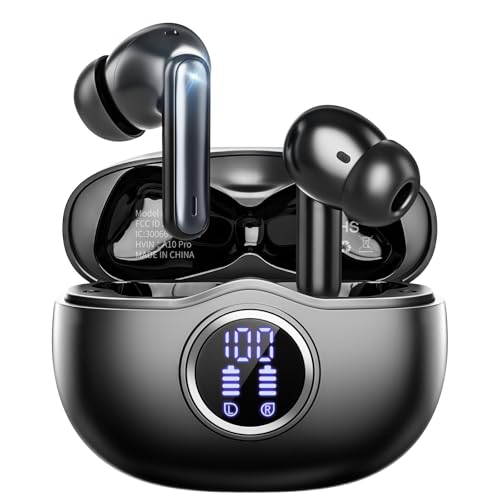
Best for: Budget-minded gym and running listeners
The Fhumsh A10 wireless earbuds pair Bluetooth 5.3 with 13mm drivers, an LED charging case, and three pairs of gel tips in small, medium, and large sizes. Each earbud is rated for up to 8 hours, while the case brings total listening time to a claimed 50 hours. USB-C charging takes about 1.5 hours, and the display shows separate battery levels from 0% to 100%.
Their strongest feature is the fitness-focused design. Earhooks help keep the buds in place, while an IPX7 water-resistance rating and internal nano-coating provide protection against sweat and water exposure. The case weighs about 0.09 pounds, and the earbuds are listed at 0.008 pounds each, though that earbud figure may be a listing error. ENC microphones target clearer calls, while Bluetooth 5.3 supports connections up to 15 meters under suitable conditions. At around $20, they offer a lot of hardware for a low price, but buyers should keep expectations realistic about sound tuning and call performance.
Pros
- LED case display shows each earbud’s battery level separately.
- Up to 50 hours of claimed playback suits travel and repeated workouts.
- Earhooks, three tip sizes, and IPX7 protection support active use.
Cons
- ENC improves microphone pickup, but it is not the same as active noise cancellation.
- No companion app, EQ controls, or codec support is listed for sound customization.
3. Fhumsh Wireless Earbuds

Best for: Gym users who want secure earbuds
The Fhumsh A10 is a low-cost wireless earbud set with Bluetooth 5.3, 13mm drivers, and three pairs of medical-grade gel tips in S, M, and L. Reinforced earhooks aim to keep the buds in place during running, cycling, and interval workouts. Each earbud weighs a listed 0.008 pounds, while the charging case weighs 0.09 pounds. Around $20, it targets buyers who want workout features without a premium price.
A dual-screen LED case shows separate battery levels from 0% to 100%. The earbuds are rated for up to 8 hours per charge, with a claimed 50 hours of total playback. USB-C charging takes about 1.5 hours. IPX7 protection and an internal sweat-resistant coating suit exercise, though the rating does not make the case waterproof. ENC microphones may improve call clarity, while Bluetooth 5.3 supports connections up to 15 meters under the listed conditions. The set also claims dual-device pairing for switching between a phone and laptop.
Pros
- Three tip sizes and earhooks offer a more secure fit for workouts.
- The LED case displays the battery level for each earbud.
- IPX7 protection helps guard the earbuds against sweat and water exposure.
Cons
- ENC reduces some background noise during calls, but it is not active noise cancellation for music.
- The advertised 50-hour total depends on the case and playback conditions, so actual battery life may vary.
2. TRAUSI Open Ear Wireless Earbuds

Best for: Runners who need street awareness
These TRAUSI wireless earbuds use an open-ear design with earhooks, so they sit outside the ear canal while leaving nearby sounds audible. Bluetooth 5.4 supports pairing with phones, tablets, and laptops, while touch controls handle playback, tracks, volume, calls, and voice assistants. The IPX7 rating adds water protection for sweaty workouts and rainy runs.
The charging case raises total listening time to a claimed 80 hours, and fast charging helps reduce downtime. That figure applies to the earbuds plus case, not one charge. ENC is aimed at clearer calls, rather than blocking music-room noise. At around $26, the standout mix is practical: open-ear awareness, a secure sport fit, water resistance, and a long battery reserve. The eco-friendly material claim is broad, with no specific material breakdown listed.
Pros
- Open-ear placement keeps traffic, teammates, and other surroundings easier to hear.
- IPX7 water resistance suits sweaty training and wet-weather use.
- Bluetooth 5.4, touch controls, and up to 80 hours with the case add daily convenience.
Cons
- Open earbuds let in outside noise, so bass and detail may sound weaker than with sealed in-ear models.
- The 80-hour figure includes the charging case, and the product listing does not state the earbuds’ per-charge runtime.
1. Wireless Bluetooth Sport Earbuds with Earhooks

Best for: runners needing secure earhooks
These wireless sport earbuds use Bluetooth 5.4 and dual-channel transmission for a claimed range of up to 50 feet without obstacles. They pair automatically when removed from the case and support iOS, Android, and Windows devices. Each earbud weighs 7 grams and includes a soft earhook, plus three silicone tip sizes, S, M, and L. Around $21, they offer a low-cost option for workouts, commuting, and calls.
Battery life reaches up to 6 hours per charge, or 54 hours with the 400mAh USB-C case. A 10-minute charge provides about 2 hours of playback, while a full case charge takes roughly 1.5 hours. The LED percentage display makes the remaining power easy to check. IPX7 protection covers sweat, rain, and splashes, but the earbuds are not designed for submersion. Their noise-cancelling microphone may improve call clarity, though it does not mean the earbuds provide active noise cancellation for music.
Pros
- Earhooks and three tip sizes help create a more secure workout fit.
- The case extends total playback to a claimed 54 hours.
- IPX7 protection suits sweaty runs and rainy outdoor use.
Cons
- IPX7 does not make these earbuds suitable for swimming or underwater use.
- The 6-hour single-charge limit may require frequent charging during long trips.
Buying Guide
Heat tolerance is the first filter. A sauna can reach 150–200°F (65–93°C), far beyond many earbuds’ operating limits, so choose a model with clear heat approval or keep electronics outside.
- Temperature rating: Look for a published operating range reaching at least 158°F (70°C), then compare it with your sauna. An IP rating does not prove heat safety.
- Moisture protection: Choose IPX7 or IP68 protection if the manufacturer permits sauna use. These ratings cover water exposure, not hot steam, so treat them as secondary.
- Battery life: Aim for 6–8 hours per charge. That covers several 10–20-minute sessions, but let the earbuds cool before charging them.
- Fit and controls: Pick low-profile buds with at least three ear-tip sizes. Physical buttons can be easier to use than touch controls with wet fingers.
- Price and warranty: A reasonable target is $50–$150. Confirm that the warranty covers sweat, moisture, and heat, since many exclude damage from extreme temperatures.
If you cannot get every feature, prioritize the manufacturer’s explicit temperature rating over battery life, sound modes, or price.
Frequently Asked Questions
Can you wear wireless earbuds in a sauna?
You should not wear wireless earbuds in a sauna because heat and steam can damage batteries, seals, and internal electronics. Most consumer models are designed for ordinary room temperatures, not sauna conditions around 150°F to 200°F. Moisture can also enter during cooling, even when an earbud carries an IP rating.
How hot can Bluetooth earbuds safely get in a sauna?
Bluetooth earbuds are safe only up to the maximum operating temperature listed by their manufacturer, and many are not rated for sauna heat. Consumer electronics often specify a range near 32°F to 95°F, while saunas commonly reach 150°F to 200°F. Check the manual before exposing any wireless audio device.
What should I look for in earbuds for sauna use?
Look for a model whose manual explicitly permits sauna temperatures, steam exposure, and sweat, because water resistance alone does not make earbuds sauna-safe. Check the operating-temperature range, warranty exclusions, and charging-case limits. An IPX7 rating addresses water immersion, not prolonged heat or hot, humid air.
Are waterproof earbuds safe to use in a sauna?
No, waterproof earbuds are not automatically safe in a sauna because IP ratings cover water and dust, not high heat. An IPX7 rating, for example, addresses temporary immersion in fresh water under test conditions. It does not promise safe operation at 180°F, and heat may shorten battery life or damage adhesives.
Conclusion
Wireless Bluetooth Sport Earbuds with Earhooks are the top pick for sauna users who want a secure fit during light workouts, walks, or short cooling-room sessions. If your priority is lower cost or a smaller profile, choose a simpler waterproof pair instead, but confirm it is rated for the heat and humidity a sauna creates. Before buying, double-check the earbud and hook size, phone compatibility, included quantity, current price, and the manufacturer’s heat, sweat, and water limits. Most consumer earbuds are not designed for sauna temperatures, so use them only when the maker allows it, keep sessions brief, and remove them if they become hot, disconnect, or feel uncomfortable. A little caution can protect both your ears and your electronics.