
6 Best Battery Charger for Diesel Truck for Winter Use
The Schumacher Electric SC1445 Battery Starter/Charger is the best battery charger for diesel truck for most buyers. Its 200-amp engine-start setting gives large 12-volt and 24-volt batteries the extra power diesel engines often need. This wheeled unit also provides charging and boosting functions, so it can handle more than one emergency start. It suits pickups, work trucks, and other heavy-duty vehicles.
This guide is for diesel pickup owners, fleet managers, and drivers who need dependable recovery gear at home or on a jobsite. For this charger type, check engine-start amperage first, then voltage support and portability. A wheeled frame fits garage use, while a lighter unit works better in a service truck. The six picks below are ranked with clear reasons and honest drawbacks for each.
Quick Comparison
| # | Product | Best For | Price | |
|---|---|---|---|---|
| 1 | Schumacher Electric SC1445 Battery Starter/Charger | Heavy-Duty Battery Starting | ~$190 | View → |
| 2 | NOCO GENIUS2X2 Battery Charger | Dual-Battery Charging Setup | ~$100 | View → |
| 3 | NOCO GENIUS1 Smart Battery Charger and Maintainer | Compact Battery Maintenance | ~$30 | View → |
| 4 | VTOMAN V-Truck Pro Jump Starter | Truck Emergency Jump Starts | ~$210 | View → |
| 5 | PCHH 12V/24V Car Battery Charger | 12V And 24V Vehicles | ~$113 | View → |
| 6 | Portable Car Battery Jump Starter, 8000A | High-Output Portable Jumping | ~$100 | View → |
6 Top Diesel Truck Battery Chargers
The list is ranked from sixth to first, with each diesel-friendly charger judged for output, compatibility, controls, and everyday value.
6. Portable Car Battery Jump Starter, 8000A

Best for: Drivers of large vehicles and remote travel
This portable jump starter is built for 12V cars, trucks, and other vehicles with gas engines up to any listed size or diesel engines up to 12 liters. Its 8000A peak rating, 8 AWG cables, and force-start mode target batteries that will not respond to a normal connection. The case measures 10.62 by 4.68 by 5.82 inches, so it is compact enough for a vehicle emergency kit, though not pocket-sized.
The 27000mAh battery also works as a power bank. Its USB-C port supports 65W charging, with the maker claiming a charge from zero to 80% in about one hour when using a suitable adapter. A 160W DC output can run compatible 12V accessories, while the 600-lumen light offers flashlight, strobe, orange warning, and SOS modes. The 3.3-inch screen shows charge level and connection errors. Around $100, it includes the jump pack and cables, but not a wall charger. The casing is listed as waterproof, dustproof, and shockproof, with a 24-month standby claim.
Pros
- 8000A peak output supports vehicles with gas engines and diesel engines up to 12 liters.
- USB-C PD provides up to 65W for phones, tablets, and some laptops.
- Four light modes, a 600-lumen lamp, and a 160W DC port add roadside utility.
Cons
- A compatible 18W-or-higher charging adapter is required, but it is not included.
- The unit needs charging every three months, and connected devices must draw at least 5W.
5. PCHH 12V/24V Car Battery Charger

Best for: Garage owners maintaining lead-acid batteries
The PCHH BC-108 is a heavy-duty charger for 12V and 24V lead-acid batteries. It supports AGM, GEL, flooded, EFB, calcium, maintenance-free, and deep-cycle types. Its 0-15A output covers faster charging and lower-current maintenance. A copper coil, metal housing, and ABS casing add durability, but the unit weighs 12.2 pounds. At around $113, it costs more than compact battery maintainers.
Automatic detection selects the battery voltage, while auto shutoff stops charging at full capacity. Maintain mode sends pulse current after charging, which may help older or sulfated batteries. Repair mode is designed for batteries above 3V, though it cannot guarantee recovery from severe internal damage. Winter mode adjusts charging for cold conditions. The LCD shows voltage, current, and charge percentage. Reverse-polarity, short-circuit, overcharge, overheating, over-voltage, and over-current protection add useful safeguards. It can also support 12V electrolysis projects, and the included warranty lasts three years.
Pros
- Handles both 12V and 24V lead-acid batteries, including AGM and deep-cycle models.
- Repair, maintain, and winter modes cover more situations than a basic trickle charger.
- LCD readout displays charging percentage, voltage, and current.
Cons
- At 12.2 pounds, it is bulky for roadside kits or small storage spaces.
- It does not support lithium batteries, and repair mode only applies to batteries above 3V.
4. VTOMAN V-Truck Pro Jump Starter
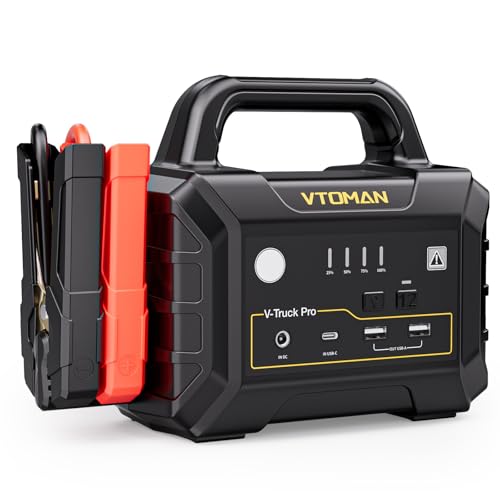
Best for: Long-haul diesel and RV owners
The VTOMAN V-Truck Pro is a 12V jump starter built for large diesel engines and heavy vehicles. Its 8,000A peak rating targets trucks, RVs, tractors, boats, and other high-compression engines. It also works with smaller 12V equipment, including motorcycles, ATVs, lawn mowers, and snowmobiles. Around $210, it costs more than basic car jump packs, but its truck-focused output gives it a wider emergency role.
Its 41,600mAh battery supports 65W charging and can reach full capacity in about 2.5 hours with the included AC adapter. VTOMAN says it can recharge a phone roughly 8 to 10 times, plus power tablets, cameras, and other USB devices. The unit measures 10 by 6 by 7.5 inches and weighs about 7 pounds. That is easier to store than an 18-pound lead-acid starter, though it remains substantial for casual drivers. Flame-retardant materials and 10 protection systems cover risks such as overcharging and excess current. A built-in light offers steady, strobe, and SOS modes. The package includes smart jumper cables, a USB-A to USB-C cable, an adapter, an instruction card, and an 18-month warranty.
Pros
- 8,000A peak output suits diesel trucks and other large 12V engines.
- 65W charging refills the battery in about 2.5 hours.
- SOS, strobe, and steady light modes help during roadside emergencies.
Cons
- It cannot start 24V commercial truck systems.
- At 7 pounds, it is still heavier than compact car-only jump starters.
3. NOCO GENIUS1 Smart Battery Charger and Maintainer

Best for: Long-term maintenance of small batteries
The NOCO GENIUS1 is a compact 1A charger, maintainer, and desulfator for 6-volt and 12-volt batteries. It supports lead-acid types such as AGM, gel, SLA, and VRLA, along with LiFePO4 lithium batteries. Use it with cars, motorcycles, lawn equipment, boats, ATVs, and similar vehicles. At around $30, it offers a practical option for seasonal storage.
Its strongest feature is automatic charging control. A built-in temperature sensor adjusts the charge for hot or cold conditions, which helps reduce overcharging and undercharging. The unit can charge batteries from 1 volt, while Force Mode can apply power to batteries that read 0 volts. Pulse charging also targets sulfation and acid buildup. The 35% smaller design saves space compared with the older G750, while a 110-inch cable gives more placement flexibility. The box includes clamps, eyelet terminals, a wall plug, and a three-year warranty.
Pros
- Supports both 6V and 12V batteries, including LiFePO4.
- Temperature sensing adjusts charging for changing conditions.
- Includes clamps and eyelet terminals with a 110-inch cable.
Cons
- The 1A output charges large automotive batteries slowly.
- Force Mode requires manual use and careful battery connection.
2. NOCO GENIUS2X2 Battery Charger

Best for: Maintaining two vehicle batteries
This two-bank charger handles 6-volt and 12-volt batteries at the same time. Its 4A charging system supports lead-acid types such as AGM, gel, SLA, VRLA, flooded, and deep-cycle batteries, plus LiFePO4 lithium-ion packs. That range covers cars, motorcycles, boats, lawn equipment, RVs, and tractors. At around $100, it costs more than a basic single-bank maintainer, but adds a second charging channel.
Each bank monitors battery condition and can remain connected for long-term maintenance. An internal temperature sensor adjusts charging in hot or cold conditions, which helps limit overcharging and undercharging. The unit can begin with batteries as low as 1 volt. Force Mode allows manual charging from zero volts, though that feature needs extra care with a battery that may be damaged. Pulse charging targets sulfation and acid stratification in compatible lead-acid batteries. The package includes two 21-inch clamp leads, two integrated eyelet terminals, four 75-inch AC cables, two 10-foot DC extension cables, and a three-year warranty.
Pros
- Charges two 6V or 12V batteries simultaneously.
- Supports AGM, gel, flooded, deep-cycle, and LiFePO4 batteries.
- Temperature compensation and long-term monitoring reduce maintenance work.
Cons
- It only supports 6V and 12V systems, so larger commercial battery setups need another charger.
- Force Mode can charge to zero volts, but using it on a failed battery requires caution and does not guarantee recovery.
1. Schumacher Electric SC1445 Battery Starter/Charger

Best for: Home garages with multiple vehicles
The Schumacher SC1445 is a wheeled, manual battery charger and engine starter for 6- and 12-volt batteries. Its 250-amp start setting targets cars, trucks, SUVs, RVs, boats, and power-sport equipment. It supports standard, AGM, gel, and deep-cycle batteries, so one unit can cover several vehicle types. At around $190, it costs more than compact plug-in chargers, but offers stronger starting and charging settings.
A 135-minute timer gives you direct control over each charging cycle. That suits owners who prefer setting a specific run time. The 25-amp and 50-amp boost settings can speed recovery for low batteries, while the 6/12-volt selector handles different electrical systems. Its wheeled cabinet makes repositioning easier, though this is a shop-style charger rather than a small trunk unit. The manual controls also require more attention than an automatic charger. The package includes the SC1445 and a user manual.
Pros
- A 250-amp engine-start setting supports larger vehicles, including trucks, SUVs, and RVs.
- 25-amp and 50-amp charging settings help restore low batteries faster than low-output maintainers.
- Works with 6- and 12-volt standard, AGM, gel, and deep-cycle batteries.
Cons
- The manual 135-minute timer requires users to choose settings and monitor the charging cycle.
- Its wheeled, shop-style format takes more storage space than a compact charger or portable jump starter.
Buying Guide
The key choice is matching the charger’s voltage and current to the truck’s battery bank. A mismatch can prevent charging or damage batteries, especially on trucks with two batteries.
- Voltage compatibility: Confirm the system before buying. Most pickups use 12 volts, while some commercial diesels use 24 volts. A 24-volt charger should not connect to a 12-volt system.
- Charging current: Choose about 10 amps for maintenance, 15 to 30 amps for routine charging, or 40 amps and higher for faster recovery. Check the instructions for dual-battery setups.
- Battery chemistry: Select modes for flooded lead-acid, AGM, or gel batteries when applicable. Lithium batteries need a charger rated for LiFePO4, not merely a “smart” label.
- Cold-weather performance: Look for operation near 0°F (-18°C) or lower if the truck stays outside. Temperature compensation can help prevent overcharging as conditions change.
- Safety and reach: Prioritize reverse-polarity protection, spark control, and overheat shutoff. Cables of at least 6 feet make connections easier on long truck batteries.
If you cannot have everything, prioritize correct voltage and an appropriate charging-current range.
Frequently Asked Questions
How do I choose a charger for a diesel truck?
Choose a charger that matches the truck’s voltage, battery type, and capacity. For most pickups, a smart 12-volt charger with 10 to 15 amps works well for routine charging of lead-acid or AGM batteries. A truck with a 24-volt electrical system needs a charger specifically rated for 24 volts.
What charging rate is best for a diesel truck battery?
A 10-amp charger suits routine charging, while a 15-amp model can replenish a large diesel battery faster. Lower settings, such as 2 amps, work better for small batteries or long maintenance cycles. Avoid choosing solely by maximum output, since excessive current can overheat or damage some batteries.
Can a regular car charger charge a diesel truck battery?
Yes, a regular car charger can charge a diesel truck battery if it matches the battery’s voltage and chemistry. A 12-volt charger may work for many pickups, but it can take longer with two batteries or high-capacity packs. Check the charger’s maximum battery size and confirm the truck does not use 24 volts.
Are smart chargers safe for diesel truck batteries?
Smart chargers are generally safe for diesel truck batteries when their voltage, battery type, and output match the vehicle. Many automatically reduce or stop current after reaching full charge, which helps prevent overcharging. Look for reverse-polarity protection and settings for AGM or flooded batteries, especially when charging overnight.
Conclusion
Schumacher Electric SC1445 Battery Starter/Charger remains the top pick for truck owners who need high starting power, manual controls, and enough capacity for large diesel batteries. If portability matters more than heavy-duty output, choose a compact automatic charger with a lower amp rating because it takes up less storage space and simplifies routine maintenance. Before buying, double-check the charger’s size, compatibility with your battery, quantity needed for your trucks, and current price. Also confirm that it supports your battery type, voltage, and charging mode. A model with a jump-start function can help during a roadside emergency, but it may weigh more than a maintenance-only unit. For fleet use, compare cable length, warranty coverage, and storage needs before ordering.